Behind the Scenes
Why PanelWave Exists
Digital comics have had two options for twenty years: shrink the printed page onto a phone, or turn the story into a video that takes the reader's hands off the wheel. PanelWave is the third path: an open format, an open-source player, and a studio for making interactive graphic novels. This is the first post, and it explains the shape of the thing and why it is built this way.
Hello. This is the first post on a blog that will mostly be about craft: how to letter a balloon so it survives a phone screen, how to branch a story without losing your mind, how to publish in five languages. Before any of that, it seems fair to say what PanelWave is and why it exists at all.
The two compromises
For as long as comics have been on screens, they have had two options. The first is the scanned page: a composition designed for paper, shrunk onto a phone, read by pinching and zooming, with the language baked into the artwork so a translation means re-lettering every page. It preserves the art and loses the reader. The second is the motion comic: panels turned into shots on a timeline, with music and camera moves and a play button. It gains mood and loses agency. Someone else runs the clock, nothing holds still, and the door in the background does not open.
Neither felt right to me. Graphic novels are a medium of stillness and pacing; the reader decides how long to look at a panel, and that decision is part of the reading. But screens can do things paper cannot: remember a choice, switch a language, play a sound when a door opens, adapt a composition to the device in your hand. The question was whether you could have both. Keep the art and the pacing, add the interactivity and the control, and do it in a way that does not belong to any one platform.
The third path
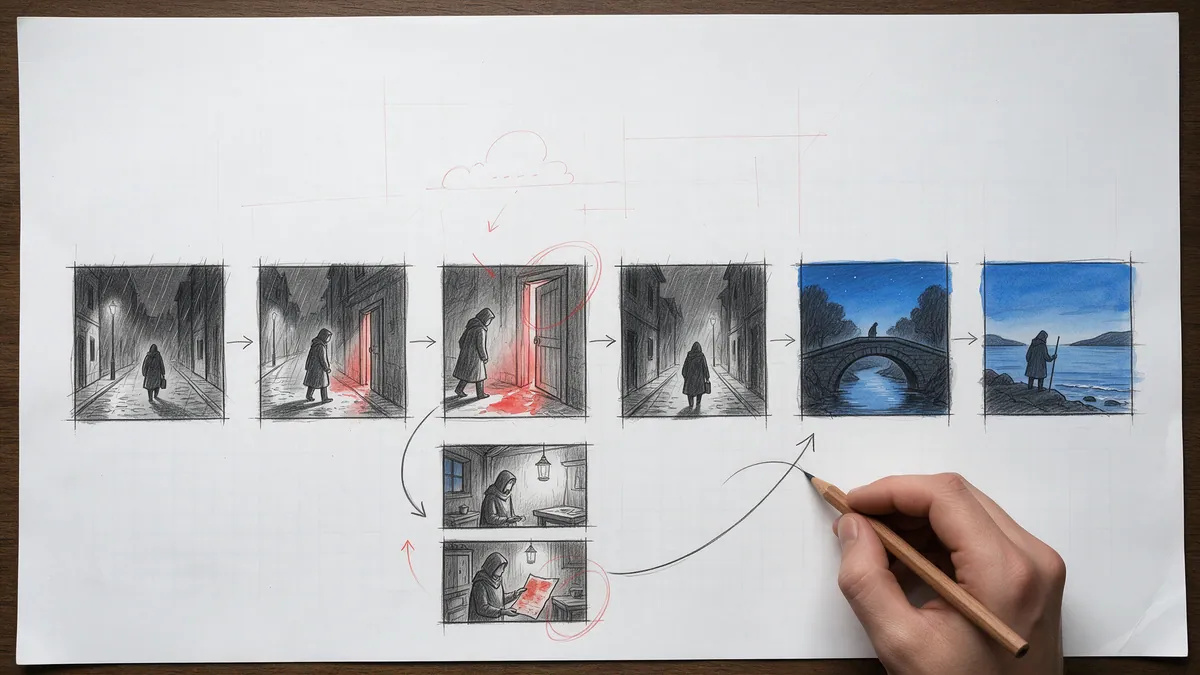
PanelWave's answer starts with what a panel is. On paper a panel is a drawing. On a screen it does not have to be: it can be a short video, nowadays quite possibly AI-generated from a hand-drawn image, that breathes for a few seconds while the reader looks at it and then holds still. That was one of the strongest reasons to build PanelWave at all. A format that treats a panel as a node with layers, rather than as a picture, can hold an image, a video, text and sound in the same place, and the reader still decides when to move on. The artwork stays the artist's; the motion becomes a choice per panel instead of a decision to make a film.
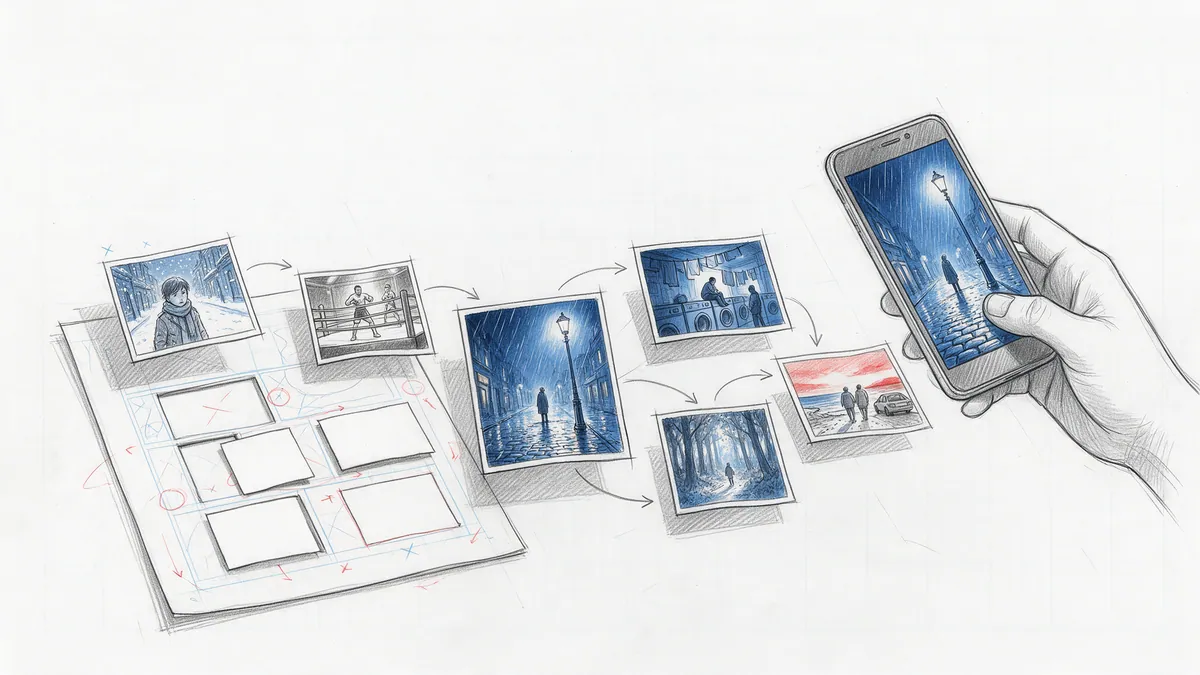
The second idea is how those panels connect. A chapter is not a sequence of pages, it is a graph. Panels are nodes, and edges say which panel may follow which, under what condition, with what transition. A conventional comic is a chain of edges; a choice is two edges with different conditions. Readers get pace, path and the ability to come back; creators get branching that is data rather than code. Everything else, layered artwork, speech balloons, hotspots, audio, video, translations, paywalls, hangs off that graph. The documentation introduction describes the model in a page.
The third idea is that none of this is worth much unless the format is open, or the third path just becomes another walled garden. So the PanelWave manifest is a JSON document with a public schema under a Creative Commons licence. Anyone can write a tool that produces it and anyone can write a reader that renders it, and the work you make in it is yours to take anywhere (Format, and the format page on this site).
Three layers, one contract
PanelWave is three things that share one definition of a story.
The format and the player are free and permissive. The CMS is where we earn our living. Creators can use as much or as little of the stack as they like: author in the CMS and self-host with the player, or write manifests by hand and never sign up. That is what open core means here, and the licences are chosen so the promise holds even if you stop trusting us: export your work and leave, and it still plays.
- The format, an open JSON schema under CC BY 4.0. It is the single source of truth for the whole ecosystem; when the format changes, everything else follows it (Architecture).
- The player, an MIT-licensed Angular library that renders a manifest as a complete reading experience: graph navigation, layers, balloons, hotspots, audio, video, localization, accessibility, and a paywall adapter you wire to your own backend. Embed it on your own site and you owe nobody anything (Player, player page).
- The CMS, the commercial studio where works are authored and published: a visual editor, an asset pipeline, a localization workshop, monetization, analytics, and export to web, PDF, PowerPoint and video. It embeds the open-source player for preview, so what you see while authoring is exactly what readers get (CMS, CMS page).
Who this is for
Three groups, in the order we expect to meet them. Independent comic and webtoon creators who want motion, sound and choices in their stories without handing over a third of their income to a platform; PanelWave takes no revenue share on content sales, and the creators page explains what that looks like in practice. Publishers and studios, especially in the European bande dessinée and graphic novel tradition, who need localization, team workflows, reader analytics and multi-format export from one source. And educators and trainers, who have wanted branching scenarios with decision analytics for years and have had to build them by hand.
And readers, always. A reading experience that respects the art and the reader: your pace instead of autoplay, your path instead of rails, your language, your accessibility settings, no app required. The readers page is written for them, and everything on it follows from the graph.
Where we are
Honestly: early, and further along than early usually means. The format is specified and published at version 1.0. The player has completed its feature phases and is in testing. The CMS has its editor, graph tools, assets, localization, monetization, publishing and export in place and is being hardened for a beta. This website went up in April, and the documentation site alongside it. There is one founder, in Munich, in an office at the Ruffinihaus in the old town, building all three layers with a great deal of help from AI tooling and almost thirty years of building content management systems and social software for other people.
The plan for the rest of the year is visible on the about page: a gated beta with the first creators, a public appearance in the autumn, and a crowdfunding campaign around a curated anthology of short interactive stories. If any of that sounds like something you want to be part of, the contact page is the door.
What this blog will be
Mostly practical. Tutorials on the editor and the format. Notes on design decisions, because a format that asks people to adopt it owes them an explanation of why it looks the way it does. Product updates with the honest parts left in. Creator spotlights once there are creators to spotlight. And the occasional post like this one, about why. Thanks for reading the first one.