Community
Frankfurter Buchmesse 2026: What We Learned at the XPLR Stand
Five days in Hall 5.0, three audiences at the stand, and one sentence we will not forget: “Finally, something new.” Here is what we saw at the fair, what visitors told us, the audience we had not planned for, and what we have built in the three weeks since.
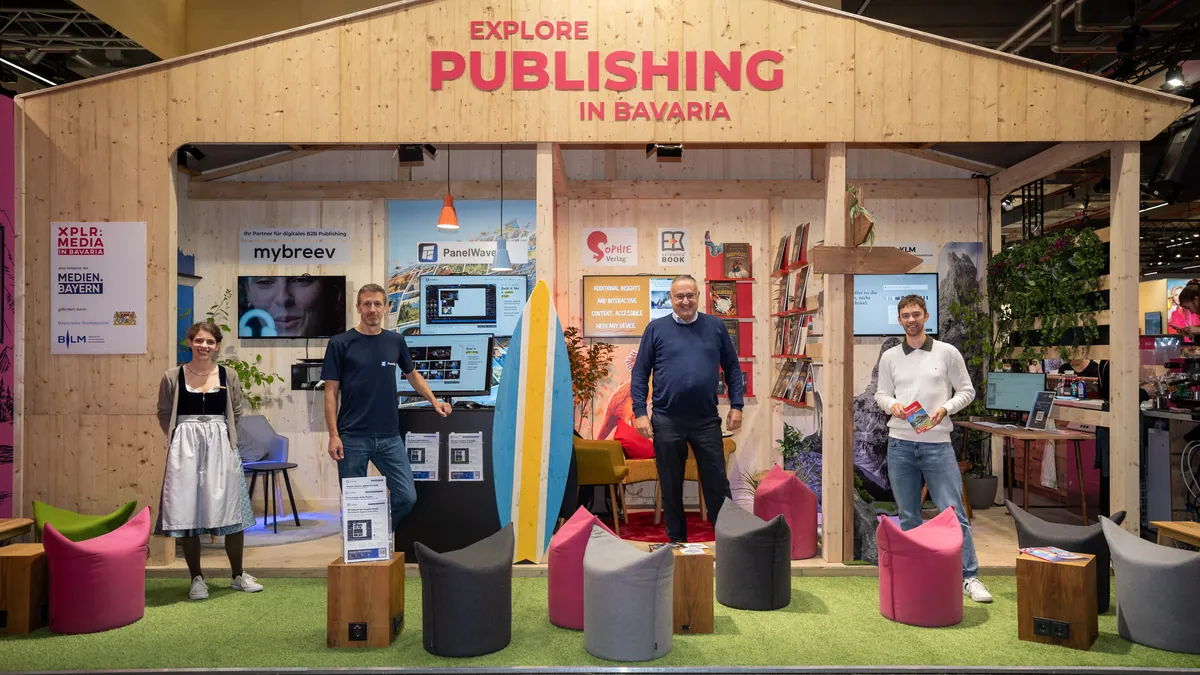
From 7 to 11 October, PanelWave was one of four Bavarian projects at the XPLR: MEDIA in Bavaria stand at the Frankfurter Buchmesse, Hall 5.0, A71. We had announced it here on the blog a few days after going public. Now the fair is three weeks behind us, and this is the recap we promised.
It is a late recap on purpose. Straight after the fair we did not post anything. We went through our notes from the stand, moved what we had heard into the roadmap, and shipped. More on that at the end.
Queues for selfies, innovation in book form
The first thing you notice at the Buchmesse is the queues. Many publishers had built photo spots for influencers and bookfluencers: scenes from their books, a manga swing, a giant open book. People queued for a picture of themselves inside a story. Wherever something was free, there was a long line, and something was free in a lot of places. Sebastian Fitzek's stand had barriers set up for the queue, for photos with motifs from his books and for prize draws. When the stand next to ours ran a giveaway, the line was so long that it was hard to reach us at all.
Innovation at the fair mostly meant new books: new titles by well-known authors and by new ones, and stage interviews with prominent writers such as Robert Habeck and Sebastian Fitzek. Technology was the exception. That made the XPLR stand, and The Länd stand of Baden-Württemberg across the aisle, good places to be: both were about innovation and technology in publishing.
Two more observations. In the international halls, many stands were staffed only from Wednesday to Friday and already cleared at the weekend. And where trade fairs like the old CeBIT were famous for their parties, book-fair evenings were quieter. There were receptions, but plenty of people seemed to prefer an evening with their new books.
At the stand: three audiences, one home run
We came with three audiences in mind: publishers, comic artists and writers, and readers. All three came by, and that was the most valuable part of the week, because each group gave us different feedback. We wrote it all down.
Whenever people stood at our corner of the stand, they were taken with the studio and the player. The live demo was a real home run. The sentence of the week came from a staff member of a large publisher: “Finally, something new.”
Our visitors came from far more fields than we expected: the owner of historical archives, self-employed psychotherapists, B2B publishers, manga festival organisers, graphic novel publishers with adult readerships, licensees, and many readers, often with a background in design or computer science, who wanted to know how it works underneath. Licensees were an interesting case: their hands are tied when it comes to changing or later animating the artwork they license.
On Friday, the first public day, XPLR hosted and moderated my interview at the stand's coffee bar: “Graphic novels & comics, made for screens”. The bar was full.
What people loved
Four things came up again and again:
- Video panels in sequence. Several panels sit on the big page, and their videos play one after another in reading order.
- The graph editor, and with it the chance to design a graphic novel interactively: panels are points on a map, choices are arrows.
- The open format and the open-source player. A work is a file you own, and it keeps working without us.
- The Work Pass. Many graphic novels are made in the evenings and at weekends, next to a day job. Paying once per work instead of a subscription means there is no clock running while you spend a year on your book.
An audience we had not planned for: B2B
The most important feedback was about an audience that was not on our list. Our direct stand neighbour, mybreev, produces compliance training for company intranets. Those courses are already multimedia, and an interactive graphic novel could make them even more engaging.
The managing director of a children's publisher gave me a tip I would not have thought of: talk to museums and memorial sites. They can no longer rely on text panels alone and need formats that reach younger visitors. An interactive graphic novel on a kiosk terminal is exactly that.
Other ideas from conversations at the stand: user manuals, recipes, job applications, visualised intranet documents and better e-learning courses. All of them are about explaining something complex with pictures and a story instead of slides.
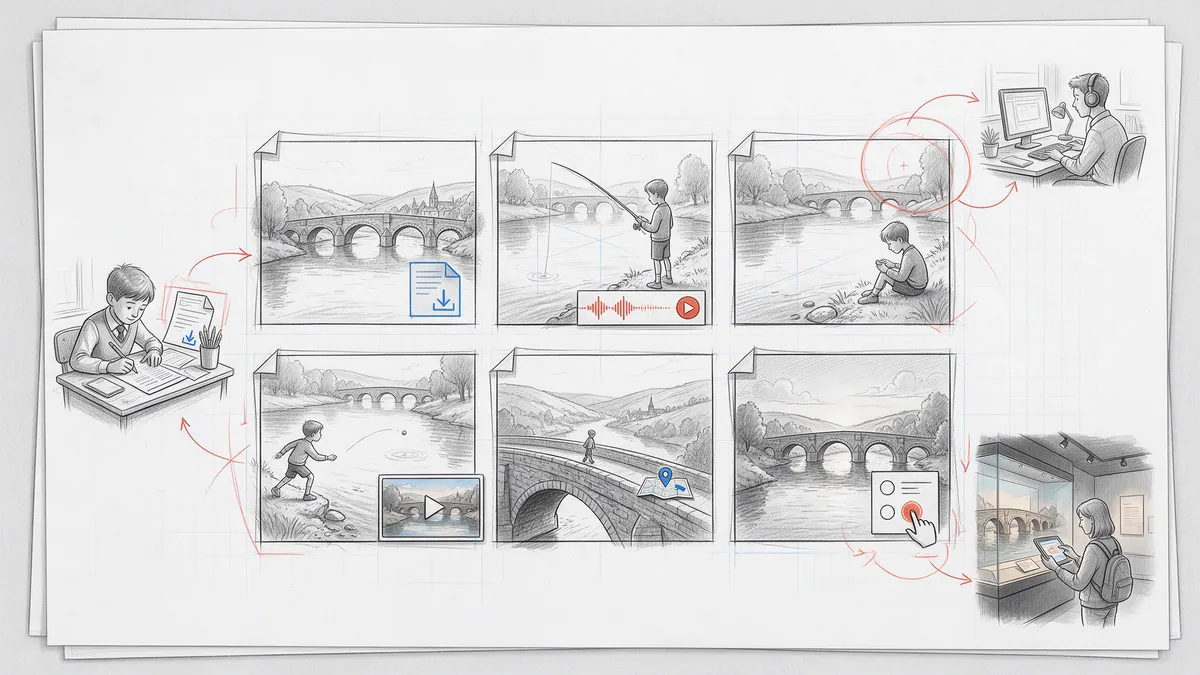
Two features we released this week fit this almost perfectly. Content widgets put downloads, an audio player, video, scroll text and embedded web pages directly on a panel. And chapter embeds place each chapter of a work as its own player on a long web page, with your own HTML in between, so a graphic novel can be interrupted by text, a quiz or a form, as a course needs it.
The QR code in the printed book
Graphic novel and comic publishers kept returning to one idea: a QR code printed in the book. It opens extended content: the story in its animated form, or branches of it, such as the backstory of a character or an alternative ending. The digital edition becomes the bonus that makes the print edition richer, and the printed appendix gets shorter, which saves printing costs.
We like this idea a lot, because it turns print and digital into partners instead of rivals. If you are a publisher and want to try it with a title from your backlist, our publisher pilot is the place to start.
Not every door opened
Children's publishers were, in part, reluctant. The credo we heard more than once: “We are trying to get children away from screens.” For them, the printed book stays at the centre, and a digital second edition is not yet on the agenda. That is a fair position, and an honest data point for us.
Where PanelWave sits in the AI debate
AI was everywhere at the fair. PanelWave mostly stays out of the “for or against generative AI” debate, because it comes in later in the process. It is a publishing tool: it assumes the material already exists and prepares it for screens.
- First, the script, written outside PanelWave, for example in a screenwriting tool like Final Draft or a specialised one like Throughline by Albert Bozesan.
- Second, the artwork: drawn by hand and scanned, painted in Photoshop or another tool, or, more and more often among a new group of creators, made with generative AI, where keeping characters and locations consistent is now largely solved.
- Third, PanelWave: panels, layers, paths, languages and sound, for every screen.
We met both sides at the stand: people who draw everything themselves, and writers who want to use AI imagery to realise a solo project in their niche.
Walking the fair also showed how many books are published every year. A funny moment made the consequence clear. At the stand of a New York publisher, a staff member asked me, visibly tired, whether I was another author trying to sell her a book. When I said it was about technology, she relaxed at once and got curious. There are many, many authors at the fair looking for a publisher, and it is not easy. That is one reason authors are interested in new ways to publish.
Self-publishing has its own problem: a few bad actors mass-produce books with AI and flood Amazon's and other platforms. A PanelWave work takes real effort, and that can be the point. A work with video panels, interactive storytelling, a panel layout for each screen format and translations is clearly different from what is on offer today. It can reach new readers without having to fight the toughest competition of the regular book market.
Then there is the platform question. Readers spend their time on big social networks, where content comes in three shapes: video, image and text. A new format needs its own home, the reader, and uses social media to be found.
Build first, post later: what we shipped since the fair
In the days before the fair, most of my time went into getting PanelWave ready to present. Sales and outreach came second, and that follow-up is happening now. The product came first after the fair as well. Between 7 and 28 October, the changelog grew by 22 entries, with three new format versions (1.8 to 1.10) and seven player releases on npm. The highlights:
- Package with player: your work and the open-source player as a ZIP, readable offline or uploaded to any web space (self-hosting).
- Lettered A4 PDF export: page view with real speech balloons, ready for print, plus print stills for video panels.
- Balloons that grow with their text in every language, and a panel view that fills the screen.
- Music, ambience and sound effects for a whole work, a chapter, a page or a single panel.
- The studio redesign: a dashboard, notifications, and every backstage tool rebuilt for 4K screens.
- Groups and per-work access, with guest and publisher roles, for publishers, studios and agencies.
- Chapter embeds and content widgets for courses, manuals and exhibitions.
- Timed balloons: on a video panel, dialogue appears in time with the clip.
Thank you to everyone who stopped by, tried the demo and told us what they need. You will find a lot of it in the list above.
Thank you to the XPLR: MEDIA in Bavaria team for the place at the stand, the moderation and a great week, and to our stand neighbours mybreev, Extended Books and TrekKI. Photos: Frank Schütz and Jens Hoppe. TARMAC Episode 1 © 2026 Peak State Entertainment GmbH, excerpt shown with permission.